-
Preprints of Accepted for inclusion in the conference proceedings - International Multidisciplinary Conference on Science, Education, Technology, and Innovation- Baku-Istanbul-2026
Historical Memory, Economic Development and Sustainable Tourism in Georgia: An Interdisciplinary PerspectiveTatia Chikadze; Salome Maisuradze; Eto Maisuradze; Anita Bezhanishvili; Nino Tushishvili; Lika BakhbakhashviliDOI:Full PDF: DOWNLOADAbstractThis paper explores the interconnection between historical memory, economic development, and sustainable tourism in Georgia through an interdisciplinary analytical framework. Drawing on perspectives from history, economics, and tourism studies, the research emphasizes how collective memory and cultural heritage function not only as identity-forming elements but also as strategic resources for regional development. The study examines selected Georgian historical landscapes and cultural sites to demonstrate how memory-based tourism contributes to local economies, employment generation, and social cohesion while preserving authenticity and cultural continuity. Particular attention is given to sustainability principles, including community participation, heritage conservation, and balanced economic growth. The findings highlight that integrating historical memory into tourism planning strengthens long-term economic resilience and enhances Georgia’s competitiveness as a cultural tourism destination. The paper contributes to ongoing debates on sustainable development by proposing a model in which heritage preservation and economic progress are mutually reinforcing rather than conflicting objectives.Keywords: historical memory; sustainable tourism; economic development; cultural heritage; GeorgiaLinguistic Forms of Diplomatic Relations Between Great Powers in the First Half of the 20th CenturyMadona Kebadze, Tamar Lekaidze, Lia Baindurashvili; Sopho NazghaidzeDOI:Full PDF: DOWNLOADAbstractThis study investigates the linguistic structures and discursive strategies that shaped diplomatic relations among major world powers during the first half of the twentieth century. By analyzing official correspondence, treaties, speeches, and diplomatic notes, the paper demonstrates how language functioned as a strategic instrument of power, persuasion, and ideological positioning. The research highlights key rhetorical patterns such as formal politeness, ambiguity, implicit threat, and symbolic legitimization, which reflected broader geopolitical tensions and shifting alliances. The interdisciplinary approach, combining historical analysis and linguistic interpretation, reveals that diplomatic language was not merely descriptive but performative—actively shaping international relations and political outcomes. The findings contribute to a deeper understanding of how linguistic choices influenced diplomacy during periods of global conflict and transformation, offering insights relevant to both historical scholarship and contemporary diplomatic studies.Keywords: diplomatic language; international relations; political discourse; great powers; 20th century history -
International Multidisciplinary Conference on Science, Education, Technology, and Innovation
Invitation Letter
International Multidisciplinary Conference

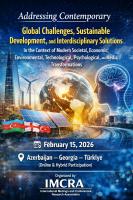
Addressing Contemporary Global Challenges, Sustainable Development, and Interdisciplinary Solutions in the Context of Modern Societal, Economic, Environmental, Technological, Psychological, and Media Transformations
📅 February 10–12, 2026
📍 Baku, Azerbaijan & Istanbul, Türkiye (Online Participation)
🌐 Organized by IMCRA
🔗 https://imcrapublishing.com/conferences/
Dear Esteemed Colleagues, Researchers, and Academics,
On behalf of the Organizing Committee, it is our distinct honor and sincere pleasure to invite you to participate in the International Multidisciplinary Conference on Science, Education, Technology, and Innovation, to be held February 10–12, 2026, in a hybrid format, with onsite sessions in Baku, Azerbaijan, and online participation coordinated from Istanbul, Türkiye.
This prestigious international academic forum is dedicated to addressing contemporary global challenges, advancing sustainable development, and promoting interdisciplinary and transdisciplinary scientific solutions within the context of rapid societal, economic, environmental, technological, psychological, and media-related transformations shaping the modern world. The conference aims to convene leading scholars, researchers, educators, practitioners, policymakers, psychologists, and media and communication specialists to exchange knowledge, present original research, and engage in high-level academic dialogue.
The conference welcomes original research contributions from all fields of science, including, but not limited to:
-
Natural and Applied Sciences
-
Engineering and Technology
-
Medical and Health Sciences
-
Social Sciences, Economics, and Public Policy
-
Education and Educational Technologies
-
Psychology, Behavioral Sciences, and Mental Health Studies
-
Media Studies, Journalism, Communication, and Digital Media
-
Environmental and Sustainability Studies
-
Information and Communication Technologies (ICT)
-
Humanities and Interdisciplinary Research
The conference is designed to foster international academic cooperation, with expected participation from scholars and researchers affiliated with more than 30 leading universities and research institutions across the United States and Europe, including (but not limited to) Harvard University, University of California system, University of Cambridge, Technical University of Denmark, and other globally recognized academic institutions.
Through keynote lectures, plenary sessions, oral and poster presentations, workshops, and panel discussions, the conference seeks to strengthen cross-disciplinary collaboration, encourage innovative research methodologies, and contribute to the global advancement of scientific knowledge, ethical communication, psychological well-being, and evidence-based policy development.
All accepted and presented papers will be published in peer-reviewed conference proceedings and will be submitted for indexing and international academic visibility through recognized scholarly databases and platforms, including:
-
ERIH PLUS
-
EBSCO
-
Elsevier SSRN
-
Web of Science – Publons
-
Google Scholar
-
Elsevier PlumX Metrics
-
Scilit (MDPI)
-
Academia.edu
-
Internet Archive (archive.org)
-
eLibrary.ru
-
SciUp
Indexing and dissemination will be carried out in accordance with international academic, editorial, and ethical standards, ensuring transparency, citation tracking, and global research visibility.
We would be deeply honored by your participation and valuable scholarly contribution to this international scientific gathering. Your expertise and research will play a vital role in shaping meaningful academic discourse and advancing sustainable and interdisciplinary solutions to the complex challenges facing our global society.
We look forward to welcoming you to this distinguished conference.
With highest regards and sincere respect,
The Organizing Committee
International Conference on Science, Education, Technology, and Innovation
International Meetings and Conferences Research Association (IMCRA)
🌐 https://imcrapublishing.com/conferences/For Submission: info@imcrapublishing.com
Publication Languages, Editorial Participation, and Proceedings
Participants are invited to submit and publish their scientific articles in English or French.
Qualified scholars and researchers may also apply to become members of the Conference Editorial Board, contributing to the peer-review, academic evaluation, and quality assurance processes of the conference.
All accepted and presented manuscripts will be published in the official Conference Proceedings, subject to a double-blind peer-review process and in full compliance with international academic, editorial, and publication ethics standards.
Manuscript Preparation and Submission Guidelines
Authors are requested to prepare their manuscripts according to the following specifications:
-
Manuscript length: 6–15 pages
-
Font type: Times New Roman
-
Font size: 12-point
-
Line spacing: Single (1.0)
-
Page margins: 2 cm on all sides (top, bottom, left, and right)
-
Text alignment: Justified
Manuscripts must be original, unpublished, and not under consideration for publication elsewhere at the time of submission.
References and Citations (APA 7th Edition)
All in-text citations and reference lists must be prepared in accordance with the American Psychological Association (APA) Publication Manual, 7th Edition.
Key requirements include:
-
In-text citations: Author–date format
-
Example: (Smith, 2023)
-
Two authors: (Smith & Brown, 2024)
-
Three or more authors: (Smith et al., 2025)
-
-
Reference list:
-
Must be placed at the end of the manuscript
-
Listed alphabetically by the first author’s surname
-
Include DOIs or URLs where available
-
Use a hanging indent (0.5 inch / 1.27 cm)
-
Examples (APA 7):
-
Journal article:
Smith, J. A., & Brown, L. T. (2024). Digital transformation in higher education. Journal of Educational Innovation, 15(2), 112–128. https://doi.org/10.xxxx/xxxxx
-
Book:
Creswell, J. W. (2018). Research design: Qualitative, quantitative, and mixed methods approaches (5th ed.). SAGE Publications.
-
Online source:
World Health Organization. (2023). Global health and sustainable development. https://www.who.int
Authors are fully responsible for the accuracy, completeness, and ethical integrity of all references and citations.
Conference Service Fee
A conference service fee of USD 75 applies to accepted submissions.
This fee covers only academic and technical services, including:-
Manuscript formatting
-
Academic editing
-
DOI registration and publication processing
⚠️ Important Policy Notice:
-
The conference service fee is non-refundable.
-
In the event that an author withdraws their paper after acceptance, the conference fee remains payable, as editorial, technical, and DOI-related services are initiated upon acceptance.
-
By submitting a paper, authors acknowledge and agree to this policy.
Why Participate?
-
Present your research on an international academic platform
-
Engage with scholars from multiple disciplines and countries
-
Increase the visibility and academic impact of your work
-
Receive DOI-indexed conference publication
-
Contribute to global discussions on sustainable and interdisciplinary solutions
-